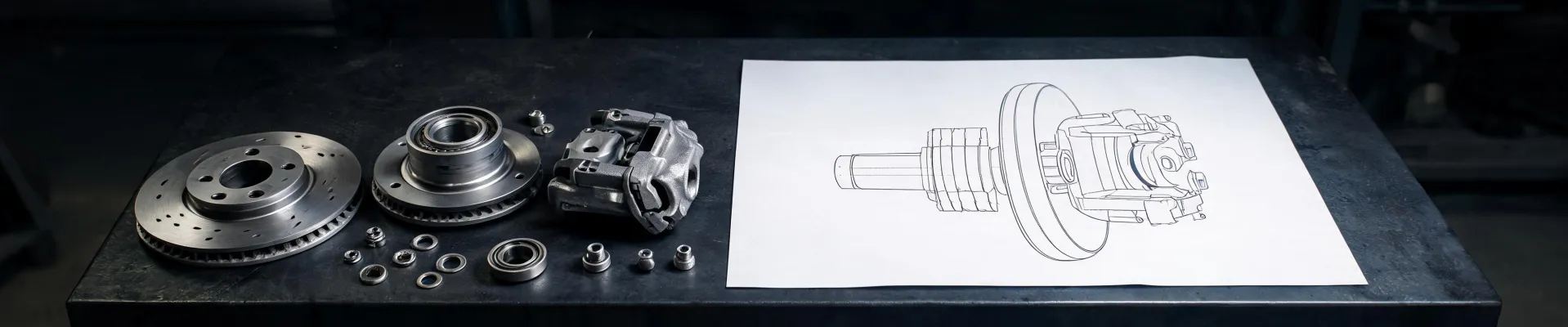
I get pulled into these comparisons a lot, usually around 4 p.m. on a Thursday, when a shop needs wheel hardware for a car that's already on a lift. So let me frame this the way I actually think about it: this isn't a review of two brands. It's a comparison between two supplier models — the broad-line generic distributor and the application-specific specialist — and the only question that matters is which one gets you the right part before your deadline.
What I'm comparing, and why
In my role coordinating emergency sourcing for a wheel-hardware supplier, I've handled 200+ rush orders over six years, including same-day turnarounds for motorsport teams and independent shops that were down a car with no hardware to put back on. When I'm triaging a rush order, three things decide whether it ships: whether the part actually fits, whether it's physically in our building, and whether the customer feels like a priority. So that's the framework here — fitment accuracy, rush response, and how each model treats a small or first-time order.
1. Fitment accuracy: where the cheaper quote usually breaks
Generic distributors win on catalog width. Application-specific suppliers win on catalog depth. For a stock replacement on a common vehicle, either can work. The moment you're dealing with alloy wheels, fitment stops being a lookup problem and becomes a specification problem.
If you're not sure what alloy wheels actually are beyond “the nicer ones,” the short version is this: they're wheels cast or forged from aluminum or magnesium alloys — lighter than steel, better at shedding heat, and usually machined for a specific lug-seat type. And that's where generic catalogs fall apart. Mag seat, cone seat, ball seat, flat seat, thread pitch, knurl diameter, shoulder length. A cross-reference table will tell you the wheel “fits.” It won't always tell you the lug seat on your aftermarket rim is a ball seat while the stud kit you've been quoted assumes a cone.
What most people don't realize is that this mismatch often passes a visual check and only shows up under torque, or after a few hundred miles. On a rush order, that's the worst possible time to find out you've been sold the wrong seat.
Application-specific suppliers — including Automotive Racing Products (ARP) grade lines — publish fitment against the actual hub and rim combination instead of a year/make/model shortcut. It's narrower. It's narrower on purpose. And when you're buying under a deadline, “probably fits” is a risk transfer you never agreed to.
Per FTC advertising guidelines, fitment and performance claims have to be substantiated — not just plausible. That standard matters more, not less, when the buyer is already out of time.
2. Rush response: “in stock” isn't the same as “ships today”
Here's the part that catches people: a large distributor's site can show “in stock” and still add a full day to your timeline. That's because “in stock” often means in stock at a partner warehouse, in another state, waiting on a transfer that has its own cut-off time. A specialist's inventory is smaller but more honest about what's actually on the shelf.
In March 2024, a client called at 4:40 p.m. on a Thursday needing a set of extended studs and a hub ring for a weekend event. Normal turnaround from their usual vendor was five business days. We had the studs on-site, the ring at a partner, and roughly six hours of shipping window left. We paid extra to pull the ring locally, bundled it with our stock, and it landed Friday morning. The client's alternative was showing up to the event without a car.
Why do rush fees exist? Because holding unpredictable inventory is expensive, and somebody has to pay for that shelf space. A supplier who pretends otherwise is either eating the cost or about to miss your deadline.
3. Minimum order sizes: how a first-time buyer gets treated
This is where the two models diverge most, and I'll state my bias plainly. Small orders shouldn't be treated as a nuisance. A shop ordering one hub ring and a tube of wheel bearing grease isn't wasting anyone's time — it's testing whether the supplier deserves a repeat order. And wheel bearing grease matters more than most buyers expect; the wrong spec can contaminate a bearing before it ever sees load. Getting a small, correct order shipped quickly is how a real relationship starts.
Big distributors often can't price a small order well, because their whole operation is tuned for volume. I get the economics. What I don't accept is the attitude — the “come back when you have a real PO” tone that buyers keep describing to me. A specialist that cares about fitment usually cares about small orders too, because the whole model is built on repeat precision, not one-time volume.
The spreadsheet said go with the volume distributor — 15% cheaper on paper for the same spec. My gut said stay with the specialist. I went with my gut, and I was thinking about a cheaper vendor that shipped us mismatched lug seats on a rush order the previous quarter. Not every gut call is right. That one was.
4. Cross-market support: terminology is part of fitment
If you sell into Spanish-speaking markets — and a lot of B2B wheel-hardware buyers do — search behavior tells you something. Customers searching for “wheel hub bearing in spanish” are really asking for the equivalent term, commonly “rodamiento del cubo de rueda,” and then a fitment answer behind it. A supplier that only operates in English on the spec side will still get the order wrong in Spanish. A specialist that builds fitment around the actual bearing and hub dimensions doesn't care what language the question arrives in.
Which one to pick
Neither model is universally better. Choose based on what you're actually buying and how much time you have.
- Go with a generic distributor when: the part is a standard replacement, the vehicle is common, the quantity is large enough to negotiate, and “estimated” delivery still fits your schedule.
- Go with an application-specific supplier when: you're fitting aftermarket alloy wheels, the order is urgent, the quantity is small (or it's your first order), or you need a real spec answer instead of a cross-reference guess. The premium you pay is mostly the cost of not being wrong on a deadline.
The lowest quote and the least risk rarely live in the same catalog — especially when the clock's already running.