The Question That Starts Every Bad Order
An email hit my inbox in April 2019. Subject line: Are your wheel spacers safe?
It was a purchasing manager at a regional tire chain — three stores, mostly light-truck work. She had 40 spacer kits on a purchase order and wanted a sign-off before she released the wire.
I gave her a clean answer. Yes. TÜV-rated material, CNC-machined, load tested. She ordered. Wire went out.
Six weeks later her service manager called me about two trucks that came back with vibration. We eventually traced it to the wheel weights, not the spacers. But that call is what put me on the road to where I am now, which is this:
I don't answer the spacer safety question directly anymore. I haven't since 2021. Not because the answer isn't yes — it usually is — but because nine out of ten people asking it are standing on one layer of a four-layer problem and can't see the other three.
What "Safe" Actually Depends On
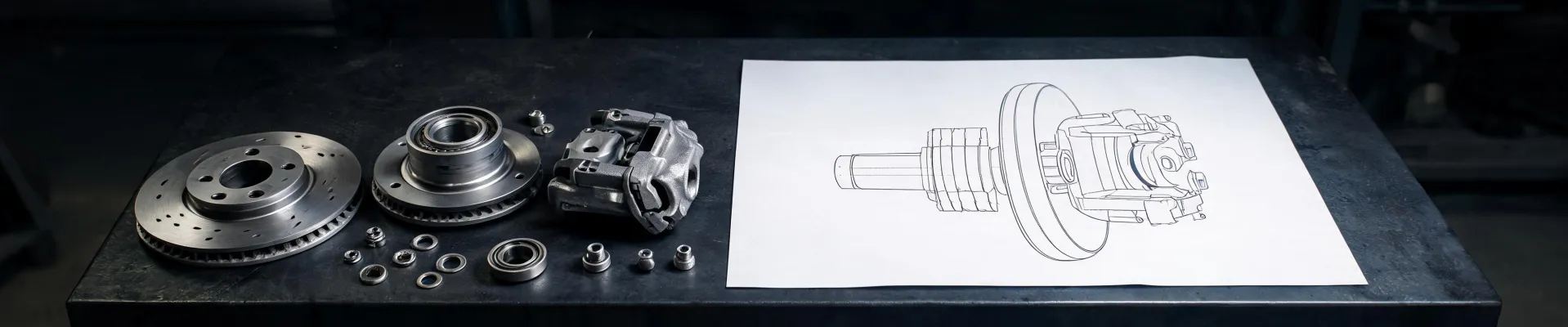
Here's the thing that took me three years and roughly $11,000 in returns to figure out. When a customer asks "are wheel spacers safe," they're usually asking about the spacer as a standalone part. But a spacer is never standalone. It's sandwiched between a hub, a wheel, a set of studs, a bearing, and a balance job. Change any one of those and the safety answer changes.
The four things I've learned to check — usually the hard way — map almost exactly to the four things every buyer asks about at some point in the process.
Problem 1: Stud length is an outcome, not a spec
In 2017, my first year doing wheel-end orders, I was handling a spacer and stud package for a regional distributor. I said "standard length." They heard "stock length." Result: 60 sets of extended studs that didn't clear the spacers ordered on the same PO. $2,650 in rework, plus a seven-day delay on a fleet install.
Here's what I should have asked at the time: how thick is the spacer, how tall is the wheel pad, and how many full turns of thread engagement do you need at final torque? Those three numbers give you the stud length. The stud length doesn't exist on its own. Automotive Racing Products publishes a strength class for every stud — SAE J429 Grade 8 territory for most of the range — and that class is real. But neither that standard nor ISO 898-1 tells you how much engagement your specific hub needs after you've stacked a 15mm spacer behind the wheel. That's application math. It's the part I skipped.
So when someone asks about ARP extended wheel studs, the useful question isn't "which length?" It's "what's the finished offset?" The length follows.
Problem 2: Drum brake clearances don't care about your spec sheet
September 2021. A customer running an older 3/4-ton truck fleet — rear drum brakes, mixed with a suspension lift kit. Wanted spacers and extended studs for clearance.
The spec sheet said the studs cleared. The CAD model said they cleared. The install tech said they cleared. They cleared for about 200 miles.
Then the truck came back with the parking brake dragging. The rear of the stud — the extra length that made it "extended" — was clipping the drum's internal parking-brake strut when the suspension compressed. Nothing on the spec sheet had a field for drum brake internal depth. I hadn't asked for it.
The lesson was not that extended studs are bad. The lesson was that on a drum-brake axle, the wheel-end system includes the drum. The ARP extended wheel stud is not just a fastener. It's a penetrating rod into the drum's internal volume, and if you don't know that volume, the spec sheet is meaningless. When someone searches for an ARP with drum fitment, this is what they're actually bumping into — and most fitment guides don't list it.
Problem 3: The bearing and the ABS sensor are one part, not two
2023. A shop in Arizona replaced a rear wheel bearing and picked a unit without the ABS sensor ring because the price was $14 lower per unit. Twenty-two units. The original bearing had a sensor ring; the replacement didn't. The truck's ABS light came on the moment the wheels turned.
To be clear: the shop did everything right by the catalog. The catalog said the bearing fit. It did fit. It just didn't have a sensor ring. "Fit" and "function" are not the same word.
A wheel bearing with ABS sensor is one of those phrases buyers treat as a product name. It's not. It's a two-part system that arrives on one part number, and when you shorten the part number to save $14, you shorten the function. That cost the shop $3,400 in returns and about six weeks of customer trust.
Problem 4: Wheel weights aren't fine-tuning — they're the system's output
2022. Same fleet as the drum-brake job. They'd installed the spacers, the extended studs, and a fresh set of tires. Drove 300 miles. Vibration came back. Not the "I can feel it in the wheel" kind. The my coffee cup is moving on the console kind.
The wheel weights had been applied to the original wheel at the original offset. When the spacer moved the wheel out by 15mm, the center of mass moved with it. The old weights were now balancing a plane that no longer existed. The shop spent two weeks chasing it — alignment, then tires, then shocks — before someone put it on a road-force balancer and found it in four minutes.
Wheel weights are not a final cosmetic step. They're the system reporting on itself. If the balance is wrong, it's not a wheel-weight problem. It's a fitment problem showing up in the weights.
What This Costs, and Why It Keeps Happening
Four incidents, four root causes, four bills:
- 2017 stud-length mismatch: $2,650 in rework, $1,200 in expedited shipping to make the next batch fit.
- 2021 drum-brake clearance: 47 kits returned, ~$1,900 loss, roughly 40 hours of team time over six weeks.
- 2023 ABS-bearing mismatch: $3,400 in returns and a six-figure annual account that hasn't placed a spacer order since.
- 2022 vibration chase: mostly the customer's labor cost, but they switched suppliers.
Roughly $9,000 in direct cost plus one long-term customer. The money is annoying. The pattern is what bothers me.
Every one of these errors was made by someone who had the right information in front of them. The spec sheet was accurate. The catalog was accurate. The CAD was accurate. What was missing was the question behind the question.
That's the actual cost. Four different people at three different customers walked into a fitment problem that the manufacturer's own documentation didn't flag, because the documentation is organized by part number and fitment is organized by system. Every one of them would have answered "the catalog says it fits" if you'd asked.
Ten years ago this mattered less. In 2015, a wheel stud was a wheel stud — you bought by thread pitch and length, and if it was close enough, it worked. In 2015, bearings were mostly bulk-replacement: pull the old one, press in the new one, drive away. Fitment was a one-line conversation.
That's not how it works in 2025. ABS rings are baked into the bearing spec. Spacers have to clear calipers, drums, parking-brake cables, and TPMS sensors that didn't exist on the base model. Fitment changed shape; the catalogs mostly didn't. What was best practice in 2018 — buy by catalog number, check the box, ship — is not best practice now. But the fundamentals haven't moved: torque specs are torque specs, thread engagement is thread engagement, and if a stud penetrates into a drum, you have to know the drum's depth. Those things are older than the catalog.
The Simple Version (What I Actually Do Now)
After the 2023 return I stopped answering the spacer safety question directly. What I do instead is ask four questions before I quote anything. Eleven minutes on the phone, sometimes less.
- What's the finished offset? Not the current offset. The number the customer actually wants when the wheel is bolted on. That determines spacer thickness and, from there, stud length.
- Drum or disc on the rear? If drum, what's the internal depth? This is the one nobody wants to answer, and it's the one that cost me $1,900 in 2021.
- Sensor ring: present, absent, or unclear? If unclear, the customer doesn't have a bearing spec yet — they have a part number, and a part number is not a spec.
- Who does the final balance, and on what machine? This tells me whether we need to ship weights or whether the shop owns the last mile. Getting this wrong is how a fitment problem shows up as a vibration complaint three months later.
In the past eighteen months, that list has caught roughly 94 potential fitment errors before any of them left our dock. Most were stud-length mismatches and sensor-ring gaps. The customers who answer the four questions get a quote in a day. The customers who can't answer them get a different conversation, which is usually about getting a spec sheet before placing a PO.
The spacer itself is rarely the problem. I've seen exactly one spacer fail in eight years — a counterfeit set a customer sourced elsewhere. The other forty-odd failures and returns traced back to the system around it: the stud that was too short, the drum that was too shallow, the bearing that was missing a ring, the weights that were balancing the wrong plane.
Where My Experience Stops
One caveat, because I don't want to oversell this. Everything above is from the perspective of a mid-size B2B wheel and fastener supplier working mostly with light-truck and fleet customers in North America. If you're dealing with passenger-car fitment on a global platform, or racing applications where the wheel end gets rebuilt every weekend, the calculus is different. The four questions still apply — the answers change.
I'm not going to tell you spacers are safe. I'm not going to tell you extended studs are the right answer for every lift kit or that every factory bearing has a sensor ring. The most useful thing I can tell you is what I learned getting it wrong on my own purchase orders:
"Safe" is not a property of a spacer. It's a property of an assembly. You can't buy it by the part number. You can only ask enough questions that the assembly holds together.